
Grand Lake Neighbors (GLN)
Wednesday, November 19, 2025
Attendance: 28, including City reps (2), NO OPD presence
Next Meeting: Wednesday, January 21, 7PM
Questions: hughesearthur@gmail.com
Brief Introduction to the Community Policing Advisory Board (CPAB) by David Ralston, District 2 CPAB member
- The CPAB supports block, neighborhood and community empowerment, civic engagement, and public safety by encouraging and supporting connection, collaboration and problem solving between neighbors and among residents throughout Oakland.
- There were approximately 22 Neighborhood Councils present at the November CPAB meeting for recertification.
- Thanks to a grant from PG&E, Oakland has $50,000 available to fund Neighborhood Councils for the year.
- The City suggested merging the CPAB with the Oakland Public Safety Planning and Oversight Commission (OPSPOC). But it looks like that is not going to happen.
- Resolution 79235, the resolution that governs community policing in Oakland, has not been updated since 2005. The CPAB is currently working on revisions to 79235 and welcomes community input.
Presentation by Zac Unger, District 1 Councilmember
- Businesses are struggling in Oakland. Councilmembers Unger, Ramachandran and Mayor Lee are proposing two business tax changes for 2027 to help businesses.
- First year free – businesses of all sizes that are new to Oakland will pay no business tax for their first year on the first $1 million in annual sales
- Small Businesses – retail shops, restaurants, salons, and similar businesses with less than $1 million in annual sales will be exempt from business tax in 2027.
- The measure to approve these changes should be on the June 2026 ballot.
- The City is working to streamline the permitting process for business.
- More permit applications can now be submitted online.
- The hours at the permitting office have been extended.
- The City is working on changing the rules to open up ground floor spaces to a wider variety of businesses.
- Certain types of permits that are always approved will no longer require an approval step. They will be issued automatically.
- Crime is down compared to the last couple of years, but it is still too high.
- James Beere has been appointed interim police chief.
- Ceasefire has been revived. 80% of the young people who go through Ceasefire do not reoffend.
- OPD is understaffed. The Council budgeted for 5 academies this year. The department is also recruiting for dispatchers. Sandra Ue, Constituent Services Director for Councilmember Wang, asked for community volunteers to work at OPD recruiting events.
- Issues that are undecided and in flux at this point.
- Flock cameras – Will OPD continue to be able to access Flock license plate data? Will new Flock cameras be added? Will data sharing rules be updated?
- Will trucks be allowed on 580?
- Good things happening in Oakland
- Bike lanes are going in.
- Oakland is repaving 100 miles of roads this year.
- The City Council is working better together this year.
- Kaiser Center is reopening.
- Oakland is an alliance partner for the Super Bowl and Word Cup.
- Although some longtime restaurants have closed, many new restaurants are opening.
Reforming the Oakland Charter: Presentation by Oakland Charter Reform Project
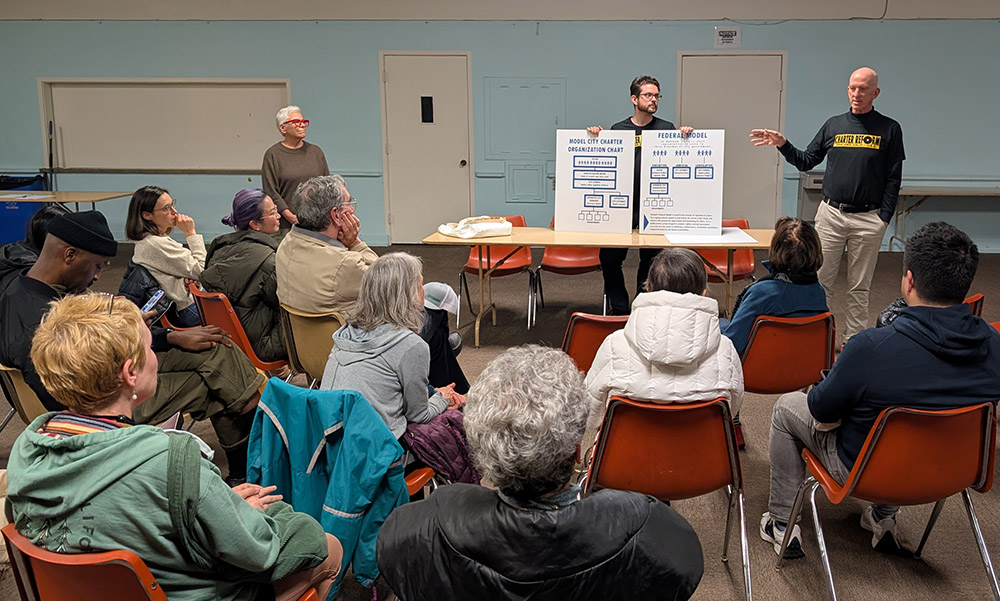
Presenting: Steven Falk with Ben Gould and Nancy Falk
https://oaklandcharterreformproject.substack.com/
- Steven is a career public administrator and has twice served as interim city administrator for Oakland.
- Oakland is more dysfunctional than any other city he has worked for. Why? Because it has a bad charter with four fundamental flaws:
- The mayor does not attend council meetings and has little say in Council decisions. This leaves the mayor disconnected from the Council’s policy decisions.
- The Council does not direct, evaluate or fire the City Administrator or any department heads.
- The City Administrator is selected by the Mayor, and leaves when a new mayor takes office. Oakland has had 6 city administrators in the last 5 years.
- The City Attorney is elected, and therefore strives to appeal to the voters. But the city charter requires the City Attorney represent the interest of the City of Oakland. This is a conflict of interest.
- The Charter Reform Project proposes that Oakland switch to the Model City Charter published by the National Civic League, first in 1900 and most recently revised in 2020. In the Model City Charter:
- The Mayor and Councilmembers are elected by the voters.
- The Mayor attends Council meetings and is the chair of the Council.
- The Council appoints the City Administrator and the City Attorney.
- This structure is similar to a corporation. The board of directors has the ultimate responsibility, and the board hires a CEO (City Administrator) to manage daily operations.
- Most California and Bay Area cities use the Model City Charter.
- Details that need to be worked out:
- Does the Mayor have veto power?
- Does the Mayor have line item-veto power for the budget?
- Does the Council have veto override power?
- How does Oakland change its charter?
- Mayor Lee has already formed a Charter Reform Working Group.
- The Council drafts a charter reform proposal and places it on an upcoming ballot.
- The voters approve or reject the Council’s proposal.
- Are there other types of charters being proposed? Yes, SPUR is proposing a strong mayor type charter – https://www.spur.org

Comments
One response to “Grand Lake Neighbors – Meeting Minutes (Nov. 19 meeting)”
Whether it is the Model City Charter or Spur’s strong mayor option, the current charter must be discarded. This is crucial for Oakland to succeed. Mayor Lee is on the right track. It should be put to the voters in 2026.