

On Lakeshore, just west of 580 and across from the library, look up and you’ll see the name Impact/Justice on top of a four-story building. As I’m always looking to see who’s doing good work in our community, I was intrigued. Even though it’s a national organization, the staff of Impact Justice was eager to tell me about what they do so that I could share it with our neighborhood.
Impact Justice is a national innovation and research center based in Oakland that’s transforming the criminal justice system from the ground up. Founded 10 years ago by former prosecutor Alex Busansky, the organization’s mission is to end mass incarceration and promote a more humane and restorative approach to justice. The organization develops criminal justice solutions which ensure that programs 1) prevent people from entering the justice system, 2) support those in prison, and 3) assist them as they re-enter society.
“Much of our work involves filling gaps in how to support people at various stages of the system,” explains Communications Director Shelby Giles, who provided me with much of the organizational background.
In addition to its Lake Merritt office, Impact Justice has offices in Washington, D.C., and Los Angeles.
The Homecoming Project

At the core of its mission is a strong belief in community, dignity, and second chances. Few programs embody this principle more than the Homecoming Project, a daring initiative that redefines how we support individuals returning home from prison.
“How can we ensure that people are not penalized forever for their worst mistake?” asks Bernadette Butler, director of the Homecoming Project. “One thing we know is that formerly incarcerated individuals are 10 times more likely to experience homelessness than the general public. And here in the Grand Lake neighborhood of Oakland, a vibrant, diverse area where we’ve worked closely with the faith-based community, that strong community has benefited the people we serve tremendously.”
Studies show that there are about 137,000 spare bedrooms across the country, with thousands in the Bay Area alone. “Our Homecoming Project aims to match people leaving prison with those who have spare bedrooms as a way to offer a stable landing for formerly incarcerated people and prevent them from falling into homelessness.” Butler explains that the program provides hosts with a monthly stipend for six months. They, in turn, offer a place to live to a person seeking a fresh start. The program is currently active in Alameda, Contra Costa, and Los Angeles Counties and has recently expanded into San Francisco.
Since 2018, the Homecoming Program has helped over 200 people find stable housing across California. “We had a slow start. At first, it was tough to convince homeowners and funders that this would be a good investment. But since the program started, 100% of our participants left their host homes with secure housing, and 98.6% left with good jobs. And, we’ve had zero recidivism,” she explains.

On the other hand, “our community members who have hosted feel that they’ve benefited from being part of the project. It’s a Win-Win-Win: participants are thriving, reconnecting with families, finding jobs, and staying out of prison. Hosts have an opportunity to help someone rebuild their lives and gain stability while filling an unused bedroom; and communities are strengthened.” Butler adds that she hasn’t met one host who says they don’t want to do it again. “Often, the way we lose hosts is that they want to keep their original people for longer than the six-month commitment.”
Hosts must have a furnished spare room with a bed and bedding, and the host needs to live in the space. Hosts go through an interview process and a home inspection to ensure that the space is safe and suitable.
Those seeking housing will have served at least ten years in prison; this ensures they are older and potentially more mature. Both hosts and participants undergo thorough screening and training, and they meet in advance to ensure it is a good match. Once matched, both receive ongoing support, including coaching, conflict resolution resources, and access to community navigators who assist with employment, budgeting, and personal development.

Through programs like the Homecoming Project, Impact Justice demonstrates that investing in people benefits everyone. As Butler puts it, “We’re not just giving people a place to stay. We’re giving them a place to belong.” Thinking about her own involvement, Butler adds, “I’m a person of strong faith. I get to live out my values every day as I do this work. It’s beautiful to see how our work strengthens communities.”
Hosts are recruited through word of mouth from other hosts and from the faith-based community, as well as through articles like this one. If you have a spare bedroom and want to help someone get back on their feet, contact Impact Justice’s Homecoming Project.
Beyond Housing: A Comprehensive Approach to Justice

While the Homecoming Project gets much of the attention, it’s just one aspect of Impact Justice’s larger mission. The organization runs several other efforts that provide solutions to systemic issues in the criminal justice system.
California Justice Leaders: This AmeriCorps program empowers formerly incarcerated individuals to serve as mentors for justice-involved youth. These leaders use their lived experience to guide young people through the challenges of reentry, offering support in areas like education, employment, and housing. “California Justice Leaders flips the script, recruiting people because of their life experiences, not in spite of them,” the organization’s website notes.
Research & Action Center: Impact Justice conducts innovative research to guide policy and practice. Projects include the Men and Trauma Project, Putting Youth First, and Housing to Healing Program Evaluation.
The Inside Impact Fund launched in 2024. It includes an advisory board composed of formerly incarcerated community leaders who oversee micro-grant applications from across California. They’ve made their first round of grants to individuals who are incarcerated enabling them to purchase items that improve their experiences, such as musical instruments and art supplies.
Project to Advance the National Prison Rape Elimination Act (PREA): Wth the goal of ending sexual abuse in confinement, the PREA project provides information, guidance, and resources to help state and local agencies comply with national standards and prepare for an audit.
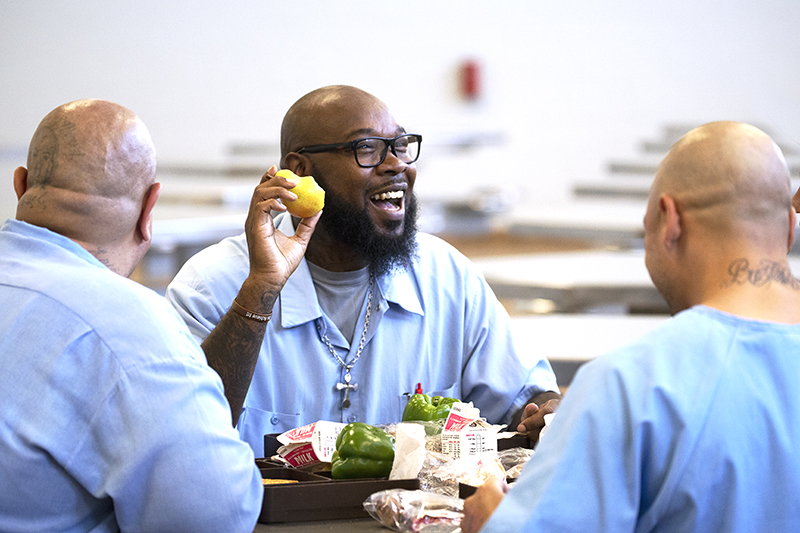
Eating Behind Bars: This initiative tackles the often-overlooked issue of food in prisons. It promotes nutritious meals and aims to end what it calls the “hidden punishment” of poor-quality prison food.
Giles notes that the organization has a book coming out as the Splashpad News goes to press. Eating Behind Bars highlights the harms of prison food —not just to those who eat it, but also to the environment, long-term health, safety, and food waste. Along with personal stories and inspiring accounts, the book features promising solutions, such as the Chefs in Prison program, piloted in Maine, to improve prison menus.
Mark your calendars now for the book event being held on January 16 at Mrs. Dalloway’s, on College Avenue in Berkeley. (Details to come.)

An additional program is on the books to launch in 2026. The Menopause Project will aim to educate women and healthcare staff behind bars. “As every woman who’s gone through it knows, menopause is a challenging stage of life, but it’s even worse behind bars,” says Giles. “We’re developing this program with medical professionals, community organizations, and those who have experienced it firsthand.”
For over ten years, Impact Justice has used research to develop unique and effective programs that strengthen community for those who are serving time or coming out of prison. Even if you can’t provide housing, you can still support Impact Justice. Visit their website and give generously.

Debra Chaplan became the publisher of the Splashpad News in February 2024. She’s lived in the Grand Lake neighborhood for 30 years. Following a career in communications and creating educational programming for several labor unions, she’s pleased to apply those skills to the neighborhood and city she loves.
